
Reiki: storie, culture e immaginari
We, the People by Frank Arjava Petter: A Review
Abstract
Frank Arjava Petter’s We, the People asks readers to carry spiritual practice into their responsibilities towards others. Writing from my involvement in Reiki and my work in anthropology, I welcome his refusal of indifference and consider how his appeal to shared humanity can remain attentive to particular lives. The review considers what Petter’s manifesto offers those who practise Reiki as an act of care. It also examines the right to refuse care and the unequal distribution of caring responsibilities.
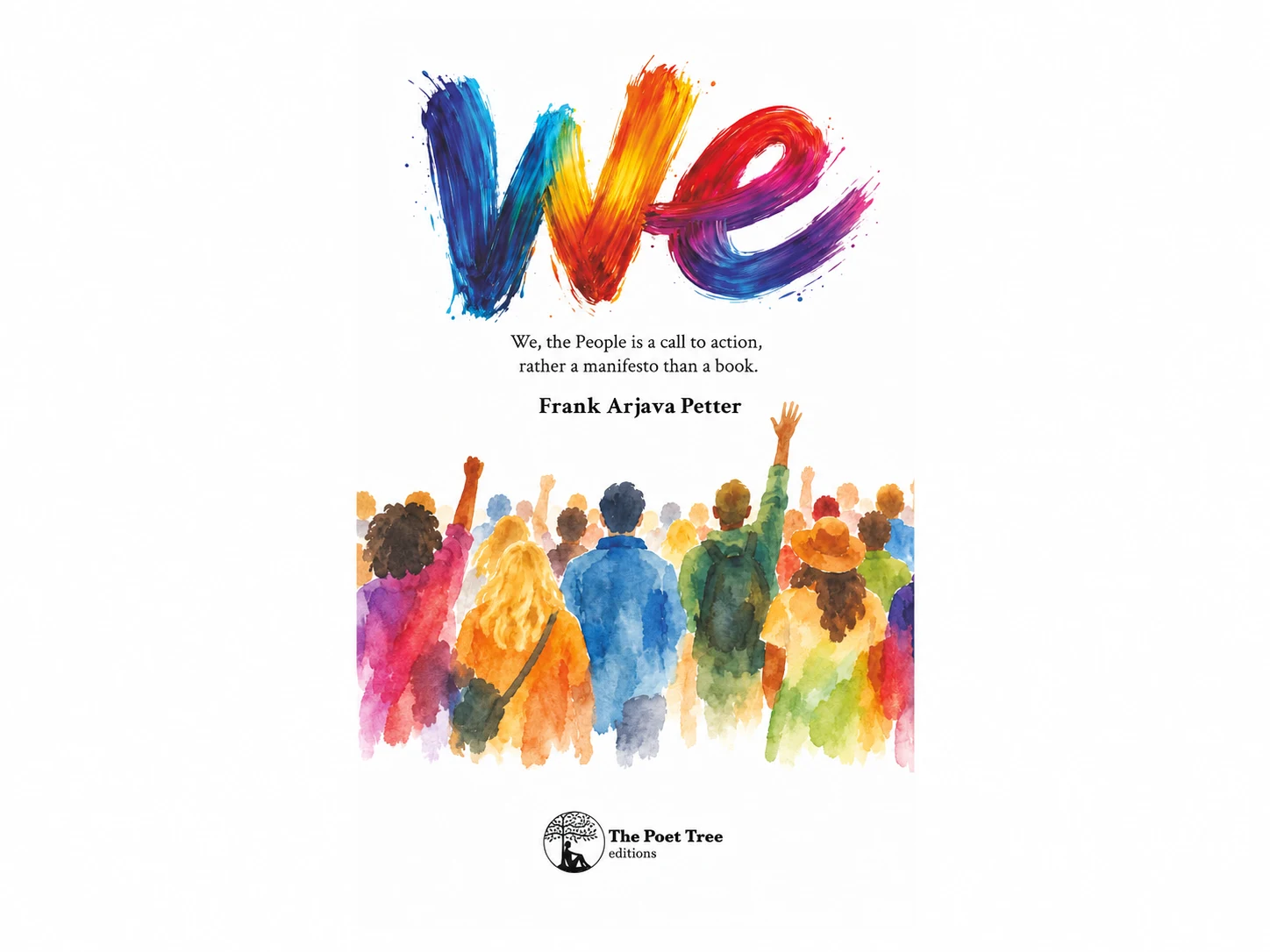
Book details
Frank Arjava Petter. We, the People. First English edition, 2026.
The prelude to Frank Arjava Petter’s We, the People ends with an unfinished sentence: “Without us…” The reader is asked to continue it. I returned to those words as I read the book. Before telling us what humanity is or ought to become, Petter gives us something to do. Leaving the sentence unfinished seems a fitting beginning for a book concerned with indifference and our capacity to care.
I read Petter with sympathy, as someone involved in Reiki whose work in anthropology brings particular lives and histories into view. His insistence that we remain responsible for the world we inhabit is compelling. He writes warmly to the reader and refuses political complacency; his concern extends to lives that are easily overlooked. His language of unity also leaves me with an anthropological question: how can a shared sense of humanity remain attentive to the differences through which people actually live?
We, the People: a manifesto for shared responsibility
Petter calls his work a manifesto. The short poetic lines address the reader directly, with autobiographical passages among alphabetical sequences of qualities, emotions and social roles. Its six chapters begin with an indictment of collective destructiveness and move towards the cultivation of attention. Difficult feelings and ecological responsibility become part of this account of participation in a shared world. Repetition gives the writing an insistent, spoken rhythm. It also encourages pauses: a brief entry can remain with the reader after a longer political passage has receded.
His recollections of postwar Germany, family fear and the bodily unease of crossing borders give a particular weight to his concern with authoritarianism. These are among the book’s most persuasive passages because we can see what his appeals owe to his own history. I understand more clearly, here, why withdrawal into personal tranquillity would be insufficient for him. Someone who practises meditation or Reiki still lives with the consequences of what happens around them.
I welcome his refusal to make spiritual practice a private shelter. His concern with violence and exclusion reaches beyond the practitioner’s inward disposition to the way they act among others. I found this invitation particularly vivid in Petter’s descriptions of ordinary conduct: walking or tending a garden, noticing other beings and speaking against cruelty. Participation becomes something a person can begin while still living with unresolved contradictions.
Reiki, attention and the encounter
How does someone learn the attention Petter asks of them? In On Human Correspondence, Tim Ingold describes living beings through lifelines that join and answer to one another. Attention develops within this movement of living together. His account helps me locate sensitivity in the course of an encounter, where another person’s response may change what we intended to do. (Ingold, 2017)
In Reiki, time given to another person is part of learning how to attend. The hands acquire meaning within that relationship. Their presence cannot be understood apart from what the other person communicates, including what remains difficult to say or uncertain.
Petter’s entry on tenderness asks us to “Touch all that you encounter with tender hands.” This is a line I would return to when thinking about Reiki. Tenderness places a demand on the person offering the gesture: they must attend to how it is received and remain answerable for it.
Reading these declarations of oneness alongside a Reiki encounter, I find myself asking how a sense of connection can make room for what we do not yet know about another person. People arrive with histories and needs we cannot assume in advance. In the entry on empathy, Petter expresses a close identification with the reader’s pain. I take this as an invitation to approach another person’s suffering with openness, while remembering that it may differ from what I recognise in myself.
Belonging without erasing difference
The problem of speaking for others runs through Lila Abu-Lughod’s Writing Against Culture. Her feminist intervention questions accounts that turn cultures into coherent, bounded wholes. Such descriptions can make cultural differences appear fixed while concealing the unequal relations connecting people. Her attention to particular lives brings me back to the collective voice of Petter’s title. How might the people gathered within this “we” give voice to their different histories and disagreements? This is a question I would carry into any attempt to describe or speak for a collective. (Abu-Lughod, 1991)
Yet addressing readers as a collective can help bring one into being. I read Petter’s repeated address as an attempt to gather people around a possible shared future. Arjun Appadurai’s Modernity at Large helps explain what is at stake in that effort. He examines imagination as a social practice shaped by migration and the circulation of media. It can furnish resources for collective action, with political consequences that remain open: imagined belonging can also sustain exclusion. I welcome Petter’s attempt, while wanting those it gathers to participate in defining the future he proposes. Their disagreements would be part of making that solidarity. (Appadurai, 1996)
The book itself bears the marks of movement across places and traditions. Christian, Hindu and Buddhist references sit beside European memories, popular music and encounters with teachers. Appadurai’s attention to circulation helps situate this composition in the world in which Petter writes. Reiki’s international life also involves translation and changes that occur as a practice travels. An anthropological reading can acknowledge its Japanese history while following how particular people receive and teach it, sometimes reinterpreting what they have learned. Who can travel or publish, and whose version becomes authoritative, affects those translations.
Reiki as an act of care
What happens when the person we hope to help needs a different response? Annemarie Mol follows such adjustments in The Logic of Care, her study of diabetes care as continuing, collaborative work. Knowledge and technologies have to be adjusted to bodies and to the circumstances of people’s lives. Patients actively take part in this material work of clinical care. Her analysis gives me a way to examine what Petter’s appeal for attention demands once someone has expressed an intention to help: we have to be willing to revise what we do. (Mol, 2008)
I understand Reiki as an act of care in this sense. A practitioner may hope for relief and improvement while recognising that the outcome exceeds their control. They still have responsibilities towards the person they accompany. The recipient’s account matters, especially when they express discomfort or refuse what is offered. A practitioner must also acknowledge the limits of their competence. This is how I would give practical content to Petter’s tenderness. The person receiving care need not share his account of universal consciousness.
Uncertainty, suffering and evidence
The brief entries on betrayal, depression or victimisation may offer encouragement through the possibility of inner transformation. Their compressed form also leaves room for readers to bring very different experiences to the same words. In a caring relationship, I would want to leave space for someone to say that an aphorism does not describe their experience, and to hear what support they feel they need.
Petter himself provides grounds for such a reading in the entry on doubt, where questioning can move a person forward. I appreciate the room this gives to uncertainty within practice. We can return to the alphabetical sequences as our circumstances change and reconsider what we once accepted.
The passages on empirical data left me wanting to explore further how evidence and lived experience might inform one another. For me, this means remaining open to evidence that asks us to reconsider an interpretation we value. Later, he recognises physicians, nurses and scientists in the collective life of the world; the lines devoted to paramedics explicitly acknowledge the limits of what can be done. These passages also speak to my understanding of Reiki. An anthropological account can examine the significance an encounter acquires for those taking part. That significance does not by itself establish a clinical benefit. Claims about therapeutic effectiveness require evidence capable of addressing them.
Feminist care ethics: generosity and its limits
In the final chapter, Petter recognises forms of work that include cleaning, nursing and childcare. I appreciated seeing people whose labour sustains everyday life included in his address. His recognition of this work also led me to consider the conditions that allow people to give it freely. Joan Tronto examines the distribution of caring responsibilities through gender, race, class and market arrangements in Caring Democracy. Some people carry more of this work while others can avoid it. Her feminist care ethics asks us to consider this inequality when we praise someone’s contribution. (Tronto, 2013)
Petter’s invitation to find meaning in carrying a burden as a service to humanity led me to think about the freedom involved in generosity, particularly when someone is being used. For me, that freedom includes being able to refuse a burden, ask for fair treatment and have time to rest.
Petter’s rejection of abuse offers a point of connection here. Refusing a burden may require support and resources that the person carrying it does not have. For Reiki, I would ask who can afford a session or set aside time to practise, and whose work makes that time possible.
Ecological care beyond the human
Mountains, rivers, forests and other beings enter the collective voice in Petter’s ecological chapter. I enjoyed this widening of the book’s address, which asks readers to notice how human life depends on relations beyond human society. Those relations carry obligations, including difficult and ambivalent ones. In Matters of Care, María Puig de la Bellacasa examines their material and political demands, following the more than human relations through which worlds are sustained. (Puig de la Bellacasa, 2017)
Consider the garden that appears in Petter’s account of ordinary conduct. Cultivating it involves water and soil organisms, as well as the work of other beings. Its consequences exceed the gardener’s sense of renewal. Puig de la Bellacasa keeps the ambivalence of such care in view: a practice may sustain some lives while neglecting or harming others. I would carry Petter’s appeal to ecological responsibility into these practical questions, following how particular acts of care affect different lives.
Indigenous knowledge and decolonial responsibility
At the opening of this chapter, Petter writes that all Indigenous cultures understand themselves as nature itself. I read this as an expression of his sympathy for ways of living that recognise our belonging within the natural world. From my anthropological perspective, I would like to explore this connection through the histories, knowledge and political struggles of particular peoples. Linda Tuhiwai Smith’s Decolonizing Methodologies examines the power involved in representing Indigenous lives and knowledge. Her work offers a way to pursue that enquiry through the voices and priorities of the people concerned. (Smith, 2021)
Smith is concerned with Indigenous struggles to reclaim authority over research and knowledge within histories of colonial domination. Here, her argument calls for precision about which peoples and sources a claim refers to, and whether those concerned can contest how their knowledge is used. Alongside admiration, I would keep open the question of who has the authority to interpret and share that knowledge. Applying these concerns to Reiki requires a separate historical enquiry: its Japanese provenance cannot simply be treated as equivalent to Indigenous knowledge. I would use Smith’s questions about who defines a practice and who benefits from its circulation while keeping those histories distinct.
Why this book matters for Reiki practitioners
I recommend We, the People for the seriousness with which Petter asks readers to respond to indifference. His autobiographical candour gives weight to this appeal. Its broad vision gives me much to reflect on, especially where my anthropological perspective leads me towards more situated accounts of human lives. His insistence that spiritual practice has public consequences is one of the reasons I value the book.
The alphabetical entries are worth returning to as readers’ own experiences and questions change. The long gathering of social roles also gives space to contributions that a narrower account of spiritual achievement might overlook. These parts of the book reward discussion.
For Reiki practitioners, that discussion can begin with what happens to the attention cultivated during a session when we return to work or encounter another person’s needs. Petter asks us to carry our practice into those relationships. My anthropological questions concern how we do so alongside people whose circumstances may differ considerably from our own.
The unfinished sentence of the prelude leaves the reader room to answer in ways Petter may not have anticipated. I hope readers keep that freedom as they move through the book and consider how its words speak to their own experience. Someone receiving Reiki also needs to be able to say what they need, including when it differs from what we intended to offer.
References
Ingold, Tim. 2017. On Human Correspondence. Journal of the Royal Anthropological Institute 23(1): 9–27.
Abu-Lughod, Lila. 1991. Writing Against Culture. In Recapturing Anthropology: Working in the Present, edited by Richard G. Fox, 137–162. School of American Research Press.
Appadurai, Arjun. 1996. Modernity at Large: Cultural Dimensions of Globalization. University of Minnesota Press.
Mol, Annemarie. 2008. The Logic of Care: Health and the Problem of Patient Choice. Routledge.
Tronto, Joan C. 2013. Caring Democracy: Markets, Equality, and Justice. New York University Press.
Puig de la Bellacasa, María. 2017. Matters of Care: Speculative Ethics in More than Human Worlds. University of Minnesota Press.
Smith, Linda Tuhiwai. 2021. Decolonizing Methodologies: Research and Indigenous Peoples. Third edition. Bloomsbury Academic/Zed Books.

L’autore
Federico Scotti
Federico Scotti è antropologo, filosofo e insegnante di Reiki tradizionale giapponese. È fondatore del Centro My Reiki a Milano, dove si occupa di formazione, pratica e ricerca sul Reiki. Il suo lavoro integra prospettiva antropologica e pratica corporea, con attenzione ai contesti culturali della cura.



La conversazione
0 commenti · uno spazio di confronto e ascolto